
Don’t Risk It — Get your report now and buy your next car with confidence.
The Mazda CX-5 is a popular medium SUV in Australia. It offers a comfortable ride, useful boot space and a good mix of features for families and daily driving. Depending on the model year, it is available with petrol or diesel engines and different equipment levels [1].
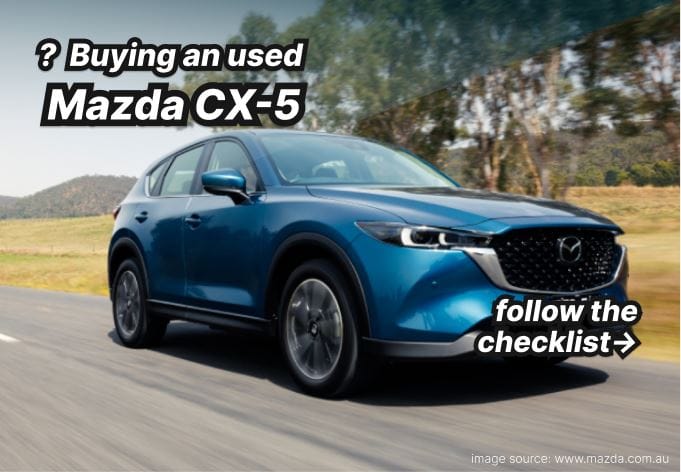
A used Mazda CX-5 can be a good choice for family trips, work and everyday travel. But before you buy, take time to check the vehicle’s condition, service records and history.
This guide will help you inspect a used Mazda CX-5 and make a better buying decision.
Why Buy a Used Mazda CX-5?
The Mazda CX-5 is worth considering for several reasons:
- Comfortable drive: It is designed for everyday driving and longer trips.
- Useful space: It has room for passengers, shopping and family luggage.
- Choice of engines: Many older models are available with petrol or diesel engines.
- Modern features: Depending on the model, you may get a reversing camera, touchscreen and driver safety systems.
- Good all-round use: It suits city driving, family travel and weekend trips.
Features, fuel use and repair costs can vary between models. Always check the exact year, variant and engine before making an offer.
1. Check the Exterior
Start by walking around the car in daylight. Look closely at the body, paint, glass and lights.
Use this checklist:
- Check for dents, scratches and rust.
- Look for different paint colours between body panels.
- Check the gaps around the doors, bonnet and tailgate.
- Look for signs of accident repairs.
- Check the windscreen for chips or cracks.
- Test the headlights, brake lights and indicators.
- Inspect the bumpers for cracks or damage.
- Check the tyres for cuts, cracks and uneven wear.
- Make sure all doors, windows and mirrors work.
Different paint shades or uneven panel gaps may mean the vehicle has had repairs. Ask the seller about any damage and request repair records if available.
2. Inspect the Engine
The Mazda CX-5 has been sold with different petrol and diesel engines over the years. The checks needed may vary depending on the engine.
Before starting the car:
- Check the engine oil and coolant levels.
- Look for oil or coolant leaks.
- Inspect hoses and visible engine parts.
- Look for signs of poor repairs.
- Check the service records for regular maintenance.
When starting the engine, listen for unusual knocking, rattling or rough running. Check for smoke from the exhaust and watch for warning lights on the dashboard.
For diesel models, ask about the diesel particulate filter (DPF), particularly if the vehicle has mainly been used for short city trips. Ask whether the car has had any emissions-system warning lights or repairs.
Do not ignore unusual noises, smoke or warning lights. Arrange a professional inspection before buying.
3. Check the Transmission and Brakes
Many Mazda CX-5 models use an automatic transmission, although the exact setup depends on the year and variant.
During your test drive:
- Check that the car moves smoothly from a stop.
- Test the shift between Drive and Reverse.
- Look for delays when changing gears.
- Listen for grinding, knocking or other unusual sounds.
- Test the brakes at a safe speed.
- Check that the car does not pull to one side when braking.
- Feel for vibration through the steering wheel or brake pedal.
- Make sure the parking brake works properly.
If the transmission slips, jerks or makes unusual noises, ask a mechanic to check it. Brake vibration or a pulling sensation may also point to a problem that needs attention.
4. Check the Tyres, Steering and Suspension
Tyres and suspension parts affect the car’s handling, comfort and safety.
Check the following:
- Tyres have suitable tread and no visible damage.
- All tyres are the correct size.
- The steering feels steady.
- The car does not pull to one side.
- There are no clunks over bumps.
- The suspension does not bounce too much.
- The wheels have no obvious cracks or damage.
- Tyre wear is reasonably even.
Uneven tyre wear may point to poor wheel alignment, worn suspension parts or past accident damage. Ask a mechanic to investigate the cause before agreeing on a price [5].
5. Test the Interior and Electronics
A clean interior can be a good sign, but you should test all the main features.
Check that:
- The air conditioning blows cold air.
- The heater works properly.
- The touchscreen responds as it should.
- Bluetooth and phone connections work.
- The reversing camera displays a clear picture.
- Electric windows and mirrors work.
- The central locking and key fobs work.
- The seats adjust correctly.
- The seatbelts lock and retract properly.
- No unexplained warning lights appear.
If the vehicle has parking sensors, cruise control or driver assistance features, test them where safe. Features vary by model year and grade, so do not assume every CX-5 has the same equipment.
6. Review the Service History
A car with a clear service history is often a better choice than one with missing records.
Ask the seller for the service book, invoices and owner’s handbook. Check whether the vehicle has been serviced at the recommended times.
Look for:
- Regular oil and filter changes.
- Records of scheduled servicing.
- Evidence of brake and tyre replacement.
- Details of major repairs.
- Records of cooling system work.
- Diesel DPF or other emissions-system repairs, if relevant.
- A record of odometer readings over time.
Check that the kilometres on the dashboard match the service records and other documents. If there are gaps in the history, ask the seller why.
For diesel models, pay close attention to the maintenance records and how the car has been used. Short trips may not suit every diesel vehicle, particularly if the DPF cannot complete its normal cleaning cycle.
7. Check the Safety Features and ANCAP Rating
Safety features can vary between CX-5 generations and variants. Check the equipment fitted to the exact vehicle.
Depending on the year and grade, features may include:
- Autonomous emergency braking.
- Blind-spot monitoring.
- Lane departure warning.
- Lane-keep assist.
- Rear parking sensors.
- A reversing camera.
The CX-5 introduced in Australia in 2017 received a five-star ANCAP rating under the testing standards used at that time. That rating expired in December 2023. The latest generation introduced in Australia in June 2026 has a separate five-star ANCAP rating [2][3].
Do not assume that every CX-5 has the latest safety rating. Check the ANCAP website using the vehicle’s model year and build date, and confirm which safety features are fitted.
8. Check for Recalls
Before buying, check whether the vehicle has any outstanding safety recalls.
Use Mazda Australia’s official support and recall information to find out whether the vehicle is affected. You can also contact a Mazda dealer and provide the vehicle’s VIN [4].
Ask the seller for proof that any recall work has been completed. If a recall is outstanding, contact an authorised Mazda dealer to confirm what needs to be done before you buy.
Do not rely only on the seller’s word that the vehicle has no recall issues.
9. Check the Warranty
Mazda Australia states that new Mazda vehicles purchased since 1 August 2018 are covered by a five-year, unlimited-kilometre factory warranty, subject to the warranty terms [5].
However, the warranty on a used CX-5 depends on its original purchase date, service history, use and any applicable conditions.
Before buying, ask Mazda or the seller to confirm:
- The original warranty start date.
- Whether any factory warranty remains.
- Whether the warranty transfers to the new owner.
- Whether the servicing meets warranty requirements.
- Whether previous repairs affect the cover.
- Whether any separate dealer warranty is offered.
Read the terms carefully. A dealer’s extended warranty may be a separate product and should not be confused with Mazda’s factory warranty.
10. Check the Vehicle History and PPSR
A test drive and mechanical inspection cannot tell you everything about a used car. A vehicle history report can help you check important records before paying.
A PPSR check (formerly known as REVS Check) can help identify whether a vehicle has a registered security interest, such as money owing. Depending on the information available, a vehicle history report may also help you check written-off status, stolen status and other vehicle details.
Before buying a used Mazda CX-5:
- Match the VIN on the car with the registration papers.
- Check the registration details.
- Review the available vehicle history.
- Check for registered finance or money owing.
- Check whether the vehicle is recorded as stolen or written off.
- Ask questions about any records you do not understand.
The Australian Government’s Personal Property Securities Register (PPSR) provides official information about security interests in personal property, including vehicles [6].
A PPSR search does not assess the engine, transmission, brakes, tyres or general mechanical condition. Arrange an independent inspection as well.
11. Take a Proper Test Drive
Always drive the CX-5 before making a final decision. Ask the seller for permission and make sure the vehicle is registered and insured for the test drive.
During the drive:
- Start the car and check the dashboard.
- Drive on quiet streets and a faster road if safe.
- Test acceleration and braking.
- Check the steering at different speeds.
- Listen for rattles, knocks or wind noise.
- Test reverse gear and parking.
- Check the air conditioning while driving.
- Make sure no warning lights appear.
For a diesel model, check that the engine runs smoothly and does not produce unusual smoke. If anything feels wrong, arrange a professional inspection before proceeding.
12. Get an Independent Vehicle Inspection
Even if the CX-5 looks clean and drives well, a mechanic may find problems that are hard to see.
Ask a qualified mechanic to inspect:
- Engine and transmission.
- Brakes and suspension.
- Tyres and steering.
- Cooling system and leaks.
- Electronic warning codes.
- Diesel DPF and emissions systems, where fitted.
- Signs of accident damage or poor repairs.
- Evidence of poor maintenance.
An inspection may cost money upfront, but it can help you avoid a much larger repair bill later.
Final Checklist Before You Buy
Before paying for a used Mazda CX-5, make sure you have:
- Checked the body, paint and glass.
- Inspected the engine.
- Tested the transmission and brakes.
- Checked the tyres, steering and suspension.
- Tested the interior and electronic features.
- Reviewed the service history.
- Checked the safety rating for the correct model year.
- Checked for outstanding recalls.
- Confirmed any remaining warranty.
- Completed a PPSR and vehicle history check.
- Taken a proper test drive.
- Arranged an independent mechanical inspection.
Conclusion
A used Mazda CX-5 can be a practical medium SUV for Australian roads. The best choice is one with a clear service history, good condition, working safety features and no major problems.
Take your time, check the records and arrange an independent inspection. Before you pay, complete a PPSR check and review the available vehicle history. These steps can help you make a more informed decision and reduce the risk of buying a car with hidden problems.
Related article Used Hyundai Kona: Pre-Purchase Checklist
References
[1] Mazda Australia – Mazda CX-5 https://www.mazda.com.au/cars/cx-5/
[2] ANCAP – Mazda CX-5 (2017–2023 model) https://www.ancap.com.au/safety-ratings/mazda/cx-5/f239a6
[3] ANCAP – Latest Mazda CX-5 Safety Rating https://www.ancap.com.au/safety-ratings/mazda/cx-5/af70b3
[4] Mazda Australia – Help and Support https://www.mazda.com.au/owners/help-and-support
[5] Cars Guide https://www.carsguide.com.au/mazda/cx-5/price/2025